THE FORT LIST
In this story

Pearl & Fourteenth · Boulder, Colorado

The Corner That Held Boulder

A bank, a post office, a theater and a Masonic lodge shared one downtown address. Then, in April 1945, the building burned.

Historic street view of the Boulder Masonic Temple at the corner of Pearl and Fourteenth
c. 1900 · BoulderThe tower marks the corner at Pearl and Fourteenth. Shops faced the street. The floor plan takes you upstairs to the theater and meeting rooms.Boulder’s Masonic Temple around 1900. Historic image digitized in Kyle Pounds’s Boulder History collection. Carnegie’s exterior photo series

This story starts on Pearl Street. Stand at Fourteenth and picture a building where you could buy stamps, do business at a bank or see a show. The people who put up the building met upstairs. Fifty years later, they were photographed in its ruins beside a safe that had fallen from their lodge rooms.

1344 Pearl Street · 1895

The Masons build on Pearl

A mortgage bond dated January 1, 1895, and a program for the March 19 cornerstone ceremony survive in the papers collected by the Boulder Daily Camera’s Paddock family. Fraser & Grant did the masonry. Contractor Andrew Fraser later told the Camera that the cornerstone weighed more than a ton and recalled stones above the entrance weighing three tons. In a speech published the following January, Dr. William L. Burdick looked ahead to a day when the building’s walls would crumble. When the building went up, it occupied the southwest corner of Pearl and Fourteenth, with more than one storefront address.

Carnegie’s photo descriptions trace the life of the building from the sidewalk. A wagon waits outside. One view shows a vaudeville sign, another a bakery sign. In a separate group portrait, Knights Templar line Pearl Street in front of the lodge. The Daily Camera’s May 28, 1898 edition reported on a packed moving-picture show at the temple and said the next performance would bring twenty new scenes.

Workers, horses and wagon in front of the Boulder Masonic Temple during construction
1895 · BoulderThe round corner bay is already recognizable while the adjoining bays are still rising. Compare it with the finished Pearl Street elevation.The temple during construction, 1895. Historical image via the Kyle Pounds Boulder History collection.
1900 Sanborn map detail marking the brick Masonic Temple, opera house and post office
November 1900 · BoulderRead across the pink footprint to find the opera house and stage. The map records uses that a street photograph cannot show.November 1900. The fire-insurance map marks the opera house and stage, Masonic rooms, offices, the post office and street-level businesses. Detail from sheet 10, Sanborn Maps Collection, Library of Congress, Geography and Map Division.

Pearl Street · 1896–1910

A bank moves west. The mail moves east.

The National State Bank was doing business in the temple by about 1896 while its own building at Thirteenth and Pearl was underway. At 1242 Pearl Street, the bank’s 1899 home gave the corner a street-level arcade in Colorado red and white sandstone and brick. Fraser & Grant worked on this building too. A construction photo catches workers at the edge of that heavy, rough-faced masonry.

A second photograph takes us inside the First National Bank at Twelfth Street, today’s Broadway. These were two banks at two corners. Carnegie also has a collection with the Boulder National Bank at 1211 Pearl, a third address to keep straight when reading old captions.

Christmas mail gets a new address

From 1900 through 1910 the post office worked out of the temple on the Fourteenth Street side. On December 10, 1910, Postmaster Frank Moorhead moved the postal materials into a purpose-built office at 1905 Fifteenth Street. The new building paired tan brick with limestone and terra-cotta detail. Inside, the lobby was lined with marble.

Carnegie’s construction series follows the building from 1909 to completion. The final photograph shows the workers and a supervisor posed on the front steps.

Workers in front of the National State Bank’s stone arches during construction
1899 · Thirteenth and Pearl, BoulderWorkers posed in front of National State Bank’s arched openings. The bank had occupied space in the temple one block east.National State Bank under construction at Thirteenth and Pearl, 1899. Historic image via Kyle Pounds.
First National Bank interior with a long counter and decorative ironwork
1898 · Twelfth and Pearl, BoulderThe teller enclosure fills the banking room. This is First National Bank, a different institution from National State Bank at Thirteenth and Pearl.First National Bank interior at Twelfth and Pearl, dated 1898 in the Kyle Pounds collection.

April 5, 1945

When the corner burned

Snow was still on the ground when fire destroyed the temple. The archive follows the scene from daylight into night, then takes the reader back to the ruins. There are photographs of the cornerstone being opened and of Masons gathered below street level around the safe that fell from the lodge above.

The lodge eventually moved into a new temple at 2205 Broadway. That building later became home to the Museum of Boulder. Museum of Boulder on the next temple

Pearl Street had already lost the old county courthouse across the street. The Greeley Daily Tribune covered the February 1932 fire and reported that University of Colorado students helped carry out records. The Art Deco courthouse that replaced it used sandstone from former Switzerland Trail railroad bridge abutments, according to the county’s historic documentation.

Smoke rises from Boulder’s Masonic Temple during the April 1945 fire
April 5, 1945 · BoulderSmoke rises behind the Pearl Street frontage. Compare the surviving walls with the construction photograph and follow the archive series into the ruins.April 5, 1945. Boulder Historical Society / Museum of Boulder, Carnegie Library for Local History, BHS 207-12-17. Image published by the City of Boulder.

The regional connection

The road north ran through Longmont

On November 7, 1883, thirty Knights Templar from Boulder’s Mount Sinai Commandery joined the procession to lay the cornerstone of Longmont’s temple. At the dedication the next May, a special train brought about ninety people, mostly Masons, from Fort Collins, Loveland and Greeley. The Longmont Ledger recorded both crowds.

In the early hours of February 13, 1905, fire gutted that temple. Its north wall fell through Thomas Butler’s hardware store. The neighboring Dickens Opera House survived. The lodge rebuilt at 312 Main Street that year. The city says the original cornerstone was reused and remains visible at the northeast corner.

The bank and the hotel

At Linden and Walnut, the Loomis & Andrews block housed the Poudre Valley bank, a hotel and the Masons’ third-floor hall. The Fort Collins lodge opened that room in December 1884. It’s a close parallel to the way Boulder’s temple brought a bank and a lodge under one roof.

Historic photograph of the Poudre Valley bank building at Linden and Walnut in Fort Collins
Linden and Walnut · Fort CollinsThe corner entrance faced two streets. Behind the upper windows, the block also accommodated hotel guests and the Masons. The 1901 map identifies their floors.Poudre Valley Bank at Linden and Walnut. The Archive at Fort Collins Museum of Discovery, H02606.
Historic view of the 1908 First National Bank in Fort Collins
1908 · College Avenue, Fort CollinsThe columns frame the recessed entrance in the bank’s opening brochure. A newspaper reported that each polished Vermont granite column weighed more than five tons.First National Bank, Fort Collins, from the 1908 opening brochure. Fort Collins History Connection, H18235.

Louisville · Lyons · Stout

Read the fronts of the buildings

High Street, Lyons

The 1881 schoolhouse and the 1894 Old Stone Church show what local quarrymen did with Lyons sandstone. The schoolhouse’s second story, added in 1900, used molded metal made to look like stone. At 401 Main, the 1917 Turner-Stevens Building housed a bank and garage behind a sandstone façade.

The quarry town under the water

Fort Collins had its own quarry story. A photograph around 1910 shows the buildings at Stout, a sandstone quarry town whose site now lies under Horsetooth Reservoir. A 1961 Coloradoan account preserves memories of the settlement.

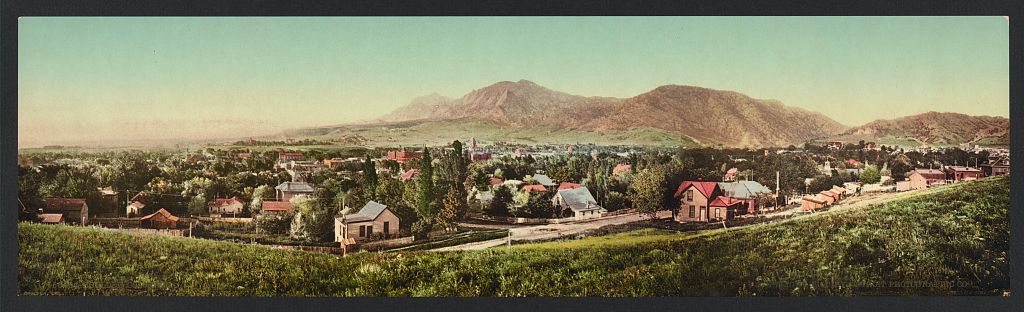
Color photochrom panorama of Boulder at the foot of the mountains around 1900
c. 1900 · BoulderThe foothills rise beyond a low downtown skyline. This photochrom was published in colour. Use the slider to examine how the print separates roofs, trees and distant ridges.Boulder around 1900. Detroit Photographic Company photochrom, Library of Congress, ppmsca 18305. Open the original to examine the downtown skyline.

The research trail

Follow the records

The links throughout the story lead to photographs, building records and newspaper pages. Some Boulder records use legacy Carnegie links. If a link opens the library homepage, the current catalog can be searched by title or call number. Some newspaper scans require a subscription. The Boulder temple’s construction program and 1945 fire coverage are indexed in Carnegie’s collections. Where the date of the Longmont fire differs across accounts, the story uses the datelined contemporary reports placing it in the early hours of February 13.

Follow the photographs

Open the cornerstone photograph or explore the temple, bank and post office photo trails.